Friday, December 23, 2016
The Irregular Guide to New York City Entry #8: Bathing in Public
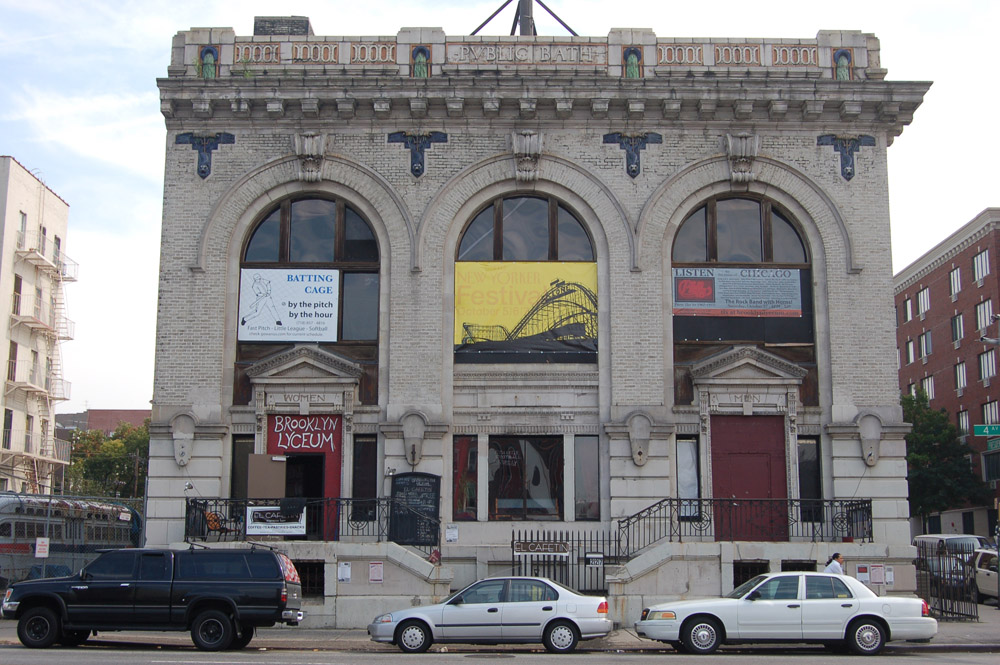
(Above: The former Public Bath #7 in Brooklyn)
If you’re exploring the Gowanus Canal, you should pay a visit to Public Bath #7 on the corner of Fourth Avenue and President Street. Today, few such buildings remain, but in the late nineteenth and early twentieth centuries, public baths like this one could be found all over the city. In those days, few people were lucky enough to have bathtubs in their homes. And only the wealthy had showers. If you were poor, a public bath may have been your only way to get clean. What better way to get to know the neighbors than to shower with them, right?
(Interested in learning more about what it was like to be poor back then? Just visit the Tenement Museum on the Lower East Side.)
Public Bath #7 is now known as the Brooklyn Lyceum, a multi-use space with a gym, theater, and café. These days, its swimming pool is empty, and its showers were removed long ago. But look closely, and you’ll spot ample proof of the building’s past. Grab a snack at the café, take a peek under the benches, and you’ll see exactly what I mean. If you’re staying in Manhattan, don’t miss one of the most beautiful public baths ever built in the city. (In fact you can even take a dip! The facility is still in use as a recreation center.) The Asser Levy Public Baths (built 1904–1906) are located on East Twenty-Third Street at Asser Levy Place.
The Irregular Guide to New York City Entry #9: Outhouses and Privies
Go for a stroll through Manhattan’s Greenwich Village or Brooklyn’s Cobble Hill, and you’ll find yourself surrounded by so many old houses that you may feel like you’ve taken a trip back in time. Many of the buildings you’ll pass were constructed in the first half of the nineteenth century. Lovely, aren’t they? Now here’s something to think about: most were built before indoor plumbing made its way to New York. So where did people go to the toilet, you ask? Why, in the backyard, of course!
Take a peek behind any old house or apartment building in New York City, and you’re likely to find a yard of some sort. Today, these little patches of ground are used for gardens or barbecue grills. But not long ago, they would have held an outhouse or privy. These structures came in all shapes and sizes. Some were quite fancy. Others were little more than a shack. But no matter how nicely an outhouse may have been decorated, it was still just an outdoor toilet built over a pit.
If you were rich, your family would have had its own outhouse. If you lived in an apartment building in a poor neighborhood like the Lower East Side of Manhattan, you probably shared the same privy with more than fifty other people. Even the deepest pits tend to fill up rather quickly when that many people are making deposits. The filth would often overflow into the courtyard and seep into neighboring basements. Keeping an outhouse or privy (somewhat) sanitary was a nasty business. Just like today, well-off New Yorkers hired others to do their dirty work. The pits beneath their outhouses were emptied by “necessary tubmen” who worked the nightshift. While the rich slumbered, the tubmen would fill their “night carts” with sewage, which they later dumped in the city’s rivers. On hot summer nights, even the wealthy couldn’t escape from the stench that followed the tubmen as they made their rounds.
Want to visit a New York outhouse? There’s a reconstructed privy at the Tenement Museum, located at 97 Orchard Street.
Want to read a bit more? Click here.
The Irregular Guide to New York City Entry #10: Chinatown's Bloody Tunnels
I promised to post about a few of New York City's underground attractions, and I will honor that promise. However, I do so with a heavy heart. As you know, this has been a terrible week for the greatest city in the world. It's been particularly brutal for those who live in Staten Island, downtown Manhattan, and the coastal parts of Brooklyn and Queens. I urge each of you to help in anyway that you can--whether that means giving a few dollars, a few cans of food or a pint of blood.
One of the reasons that the hurricane caused so much damage in downtown Manhattan is that the entire island is practically hollow. Gazing up at the skyscrapers, it's easy to forget that there are miles upon miles of tunnels beneath the asphalt. Subway tunnels. Automobile tunnels. Parking garages. And probably quite a few passages that have been forgotten over the years. Today, most streets are dry, but many of those underground spaces remain flooded. It's still too early to know how much we've lost.
So, keeping that sad fact in mind, here's the first "underground" entry in the Irregular Guide to New York City . . .
(Above: Doyers Street and the "Bloody Angle")
Long before Chinese immigrants began arriving in New York, the Manhattan neighborhood we now call Chinatown was know as Five Points. For much of the nineteenth century, it was the most notorious slum in the United States. Giant pigs roamed freely, eating garbage right out of the gutters. Violent gangs with names like the Dead Rabbits and the Pug Uglies fought to the death in the streets. The air reeked of raw sewage and rampant disease sent countless residents to an early grave.
(Above: Five Points)
While most of the people who called the slum home were honest working folks, the Five Points had a reputation as a haven for criminals. Visitors who wanted a glimpse of the “dark side” of New York would often take a tour of the neighborhood. But only the bravest would have ventured into the tunnels beneath it.
Most of the mysterious tunnels under Chinatown probably date to the Five Points days. But by the late nineteenth century, Five Points had become Chinatown, and when the Chinese gang wars erupted in the early twentieth century, the subterranean passages were used by Tong Gangs to ambush—or escape from—their enemies.
Today, many of these tunnels still exist, but few people have access to them. However, one passage is open to the public—and if you’re heading to Chinatown, you won’t want to miss it. Go to 5 Doyers Street. (The street was once known as the “Bloody Angle” because so many men died there during the gang wars.) You’ll find an ordinary door with a staircase behind it. At the bottom of the stairs is the Wing Fat Shopping Mall. This strange underground shopping center was once a dark, wood-lined tunnel lit only by kerosene lamps. The locked doors you’ll pass all lead to other tunnels. No one really knows how many there are—or what purposes they serve today.
For more information--and pictures of the Wing Fat Shopping Mall--click here!
One of the reasons that the hurricane caused so much damage in downtown Manhattan is that the entire island is practically hollow. Gazing up at the skyscrapers, it's easy to forget that there are miles upon miles of tunnels beneath the asphalt. Subway tunnels. Automobile tunnels. Parking garages. And probably quite a few passages that have been forgotten over the years. Today, most streets are dry, but many of those underground spaces remain flooded. It's still too early to know how much we've lost.
So, keeping that sad fact in mind, here's the first "underground" entry in the Irregular Guide to New York City . . .
(Above: Doyers Street and the "Bloody Angle")
Long before Chinese immigrants began arriving in New York, the Manhattan neighborhood we now call Chinatown was know as Five Points. For much of the nineteenth century, it was the most notorious slum in the United States. Giant pigs roamed freely, eating garbage right out of the gutters. Violent gangs with names like the Dead Rabbits and the Pug Uglies fought to the death in the streets. The air reeked of raw sewage and rampant disease sent countless residents to an early grave.
(Above: Five Points)
While most of the people who called the slum home were honest working folks, the Five Points had a reputation as a haven for criminals. Visitors who wanted a glimpse of the “dark side” of New York would often take a tour of the neighborhood. But only the bravest would have ventured into the tunnels beneath it.
Most of the mysterious tunnels under Chinatown probably date to the Five Points days. But by the late nineteenth century, Five Points had become Chinatown, and when the Chinese gang wars erupted in the early twentieth century, the subterranean passages were used by Tong Gangs to ambush—or escape from—their enemies.
Today, many of these tunnels still exist, but few people have access to them. However, one passage is open to the public—and if you’re heading to Chinatown, you won’t want to miss it. Go to 5 Doyers Street. (The street was once known as the “Bloody Angle” because so many men died there during the gang wars.) You’ll find an ordinary door with a staircase behind it. At the bottom of the stairs is the Wing Fat Shopping Mall. This strange underground shopping center was once a dark, wood-lined tunnel lit only by kerosene lamps. The locked doors you’ll pass all lead to other tunnels. No one really knows how many there are—or what purposes they serve today.
For more information--and pictures of the Wing Fat Shopping Mall--click here!
The Irregular Guide to New York City Entry #11: The Mystery of Track 61
(Above: The Waldorf Astoria)
Underneath the luxurious Waldorf Astoria Hotel in midtown Manhattan lies a mysterious train station. Few people have seen it, and even fewer know why it was built—or who once rode in the private train car that still sits on the tracks.
(Above: The mysterious train. Photo from Gothamist. Link below.)
Who was powerful enough to have a secret train station built beneath one of the fanciest hotels in the world? And why did he need his own private car?
In the 1940s, President Franklin Delano Roosevelt was keeping a secret from the country. He’d contracted polio decades earlier, and the disease had left him unable to walk on his own. He didn’t want the world to know about his infirmity, so he kept it carefully hidden. The secret train station beneath the Waldorf Astoria was constructed so that he could enter and leave the hotel without being seen in a wheelchair.
(Above: A rare photo of President Roosevelt in a wheelchair.)
A 1940s-era armor-clad train car (with bulletproof windows) remains parked thirty feet below the New York streets, ready to whisk FDR out of the city at a moment’s notice. Rumor has it that the station itself still serves as an emergency exit for presidents and other dignitaries whenever they come to town.
Lots of pictures here. And a cool article on hotels with secret entrances here.
The Irregular Guide to New York City Entry #12: Manhattan's Underground Cow Tunnels of Doom
**Some entries may seem a bit familiar to regular readers.**
Two hundred years ago, a strange parade took place in New York City almost every single night. If you looked out your window, you would have seen hundreds of cows trotting south to their doom. Then, in the mid-nineteenth century, New York made it illegal to herd cattle through the city’s streets. This presented a problem because most of the livestock lived on farms north of the city, while most of the slaughterhouses were located at the bottom of Manhattan island. The solution? Cow tunnels. These underground passages made it possible for farmers to drive their cows to slaughter without blocking street traffic. Eventually, the slaughterhouses moved out of town, and over time, the tunnels fell out of use.
Construction crews have been known to unearth strange wood-lined cow tunnels roughly ten feet wide and eight feet high. There’s one beneath Greenwich Street on the west side of Manhattan. And there are said to be two beneath Twelfth Avenue—one at Thirty-Fourth Street and another at Thirty-Eighth Street. The rest have been forgotten—but they’re probably still down there, just waiting to be explored.
The Irregular Guide to New York City Entry #13: The Almost Invisible Stream
(Above: Minetta Street in 1928)
The next time you’re in Greenwich Village, stop at the intersection of Minetta Street and Minetta Lane*. Are you there? Great. Now take a look around. Believe it or not, you’re standing on top of a roaring stream.
(Above: The Minettas today.)
Over a century ago, before Manhattan was flattened and covered in asphalt, the island was a pretty soggy place. Much of downtown was marshland, and dozens of creeks and small rivers trickled all over town.
As the city grew, ponds and swamps were drained, and New York’s streams were buried beneath its streets. But these “subterranean waterways” never dried up. They’re still there, flowing beneath our feet. (A good sign that you’re near one is the presence of a weeping willow tree.) There’s only one problem: very few people today know where they are. And if you start building on top of a forgotten spring, you’re going to end up with nothing more than a damp pile of bricks.
(Above: The Viele Map, my favorite map of all time. Zoomable version here.)
Fortunately, there’s a map that can tell you where to find all of Manhattan’s invisible waterways. Over five feet long and remarkably detailed, the Viele map shows all the rivers, streams, and ponds that no one has seen in over one hundred years.
But there’s still one place where you can see Minetta Creek. Inside the lobby of an apartment building at 2 Fifth Avenue, there’s a clear plastic pipe that rises out of the floor. If you visit after a rainstorm, you may notice water bubbling up into the tube. Minetta Creek flows under the building, and sometimes when the weather is wet, it decides to make an appearance.
* Another interesting note about Minetta Street and Minetta Lane: at the end of the nineteenth century, this might have been the most dangerous intersection in New York. The author Stephen Crane called the Minettas “two of the most enthusiastically murderous thoroughfares in the city.” The Minettas had a dreadful reputation and were said to be home to killers and bandits with names like Bloodthirsty and Apple Mag.
The Irregular Guide to New York City Entry #14: The Rockefeller Escape Route
740 Park Avenue has long been considered one of the most prestigious addresses on the island of Manhattan. Built seventy-five years ago, it has been home to Vanderbilts, Bouviers, Rockefellers, and royalty. To purchase an apartment in the building, you must be more than just wealthy—you must be among the world’s super-rich.
For decades, 740 Park Avenue has also been at the center of one of Manhattan’s most beloved “urban myths.” According to rumor, shortly after the building opened, John D. Rockefeller Jr. built an underground “escape route” beneath it. The tunnel is said to have led from the basement to nearby subterranean train tracks where the Rockefeller private train could carry John Jr. away from the city.
Most people, including the Rockefeller family, claim that the story is pure fantasy. Now, however, it seems that there may be more truth to the tale than previously thought. In 2006, members of the NYC Water Works were working fifteen feet beneath the street outside 740 Park Avenue when they happened upon an old vault. Inside, the plumbers discovered a series of hidden chambers connected to the building’s basement. Each had an arched ceiling roughly ten feet in height and walls composed of old bricks. No one seems to know what purpose the forgotten chambers may have served, but some have suggested that they are part of a lost tunnel built not by the Rockefellers, but by their neighbors, the Vanderbilts.
(Of course this underground discovery wasn’t the first for the NYC Water Works. They say they’ve found everything from abandoned pools to forgotten barber shops deep beneath Manhattan.)
The Irregular Guide to New York City Entry #15: The Secret Speakeasy Bookstore
Somewhere on the Upper East Side of Manhattan, on the second floor of a building in the East 80s, is a secret (and technically illegal) bookstore known as Brazenhead Books. It’s run by a man named Michael Seidenberg, who has turned his own apartment into a wonderland of used books. The store’s address is a secret, but those who find it are welcomed warmly. Once inside, there’s a chance you could end up rubbing elbows with some of New York’s best-known writers, but you’ll definitely leave with something you can’t wait to read.
Video here!
Related Reading . . .
How to Build a Secret Bookcase Door
The Irregular Guide to New York City Entry #16: The Treasure Beneath Bryant Park
Bryant Park is a lovely public space adjacent to the main branch of the New York Public Library at Forty-second Street and Fifth Avenue. It’s a great place to have lunch or watch one of the free movies they show every summer. But whenever I visit, I find it hard to concentrate on food or films. I’m too busy thinking about the treasure that’s buried below.
(Above: Bryant Park)
Hidden beneath the park are the library’s archives—two vast floors with 120,000 square feet of space and well over one hundred miles of stacks. Every single shelf holds priceless treasures: Babylonian tablets. The trunks Herman Melville took with him to sea. Theodore Dreiser’s death mask. George Washington’s recipe for beer. The archives’ contents are worth untold millions (if not billions) of dollars. I’d pay almost anything for a little more than a look.
(Above: The NYPL Reading Room)
And for what it's worth, the upstairs is amazing too. (What? Your library doesn't have chandeliers?) And the people who work there do some pretty cool stuff.
The Irregular Guide to New York City Entry #17: The Library with a Criminal Record
At the intersection of Tenth Street and Sixth Avenue, on the site of a former market and fire tower stands Jefferson Market Library. Built in 1877, the library may look like a fairy-tale castle, but it was originally a courthouse where some of the most famous murder trials in the city’s history took place. (In the basement, you can still see where the prisoners were held before they faced the jury!) Next door, on a plot of land that’s now a garden, stood a prison.
By the end of the 1920s, if you were a female criminal, this is where you were sent. The courthouse was used only for women’s trials. The actress Mae West visited in 1927 when she was charged with (and convicted of) “corrupting the morals of youth.”
If you're planning a trip to New York, be sure to check the library's website--if you're lucky, you may be able to enjoy a tour of the building's famous tower! And if that's not enough, they regularly host teen author readings (and the NYC Teen Author Festival in March)! Some of the biggest names in teen fiction take part in the readings and festival.
The Irregular Guide to New York Entry #18: Manhattan's Secret Magic Library
CH Presents: The Conjuring Arts Research Center from Cool Hunting on Vimeo.
(Yes, this is a rerun! But a good one!)
Hidden on the island of Manhattan is a library with over 11,000 books on the subject of magic. It’s called the Conjuring Arts Research Center, and if you’re clever enough to locate it, you’re welcome to visit. (And if you can’t, you can always check out the website at conjuringarts.org.)
Enter the rare books room, and you’ll find dusty tomes that date from as far back as 1480—and “mind reading” pamphlets from the seventeenth century. Many of the items collected are one of a kind. There’s even a book titled Valuable Secrets that I’d personally love to read. What kind of secrets, I wonder? And how valuable are they? If you find out, please let me know!
The Irregular Guide to New York City Entry #19: The Elevator Museum
Located in an alleyway on the border between Chinatown and Tribeca in downtown New York City, resides possibly the worlds’ smallest museum, a home to overlooked modern-day artifacts of humanism and beauty from cultures around the world.
At the bottom of a defunct elevator shaft-way, in the bowels of what was once a garment factory on lower Broadway, visitors can lose themselves among hundreds of items and their subsequent stories.
Each object is accompanied by a number which directs you to a detailed story that can be found in the museum guide or in the audio guide, accessible through any mobile phone.
Objects on display at Museum include a toothpaste tube collection and the infamous shoe that was thrown at President George W. Bush's head.
Thursday, January 1, 2015
Poisonous Pea Soup
You all know how fond I am of New York. I don't think I've ever written about my obsession with London. I adore big, sprawling cities that make little sense to outsiders. (Tokyo shares similar charms.) While I appreciate the formal beauty of towns such as Paris, I prefer chaos. I want to be surprised, shocked, or titillated every time I take a turn. London delivers. It's a big, beautiful mess. I wouldn't want to live there, but it's a city I'll never get tired of visiting.
And, of course, London's long history puts New York's four hundred years to shame. I could write a thousand posts on the strange events that have taken place in London, the bizarre figures who have called it home, and the fabulous fictional characters the city has produced over the last thousand years. (This blog is named Bank St. Irregular for a reason.)
But today, I'll focus on pea soup fogs. Like most Americans of my generation (and possibly yours), I always romanticized the fogs that once descended on London. They called to mind natty trench coats and Sherlock Holmes tales. (Not to mention Jack the Ripper.) Of course the London fogs were anything but romantic. "Pea-soupers" were a direct product of pollution. That picturesque fog was poison, and every time it rolled into town thousands of people perished.
The pea-souper of December, 1952 may have killed more than twelve thousand people. (To put that into perspective, it's almost four times the number of people who died here in New York on 9/11.) Fortunately, those deaths led to legislation that eventually cleared the skies over London.
Check out the wonderful Nickle in the Machine blog for more pictures of the 1952 killer fog. I love it when another blog does my work for me (and does a much better job than I would have done).
The Night Climbers of Cambridge


Last week, three fire engines were dispatched to Cambridge University in Britain. The firemen had been called by university officials and asked to perform a rather unusual task. A student hoaxster had placed red Santa's hats on the spires of two tall buildings, and the humorless university officials wanted the hats removed. (Read a news report here.)
That's not the interesting part. The question is: How did the hats get up there in the first place? As you can see from the photos above, the hoaxster didn't choose the most accessible rooftops.
That's why some are suggesting that the hoaxster must have made use of a book known as The Night Climbers of Cambridge. Written by the mysterious "Whipplesnaith" and published in 1937, the tome offers a guide to exploring the roofs of the city's ancient buildings. It even offers handy tips on how to get around chimneys, pillars, and gargoyles.
I love the idea of students slinking through the night, hopping from rooftop to rooftop with their trusty guide tucked into their back pockets. On the awesome meter, The Night Climbers ranks right up there with Glimpses of Gotham and the Perforating Mexicans. (Below: One of the many amazing photographs from the book.)

Want even more awesome? (I can barely take it!) You can read the entire book here.
The Color That Keeps the Ghosts Away

I love knowing the crazy origins of everyday things. Take, for example, the blue shown above. You see this and similar "watery" hues throughout the Southern US. "Haint Blues," as they're called, are used to paint ceilings, shutters, and sometimes even entire buildings. They're lovely, of course, but they serve a surprising purpose.
Here's the story, via the wonderful blog Curious Expeditions . . .
Known as the Gullah or Geechee people, the original Haint Blue creators were descendants of African slaves who worked on rice plantations in South Carolina and Georgia. . . . They are well-known for preserving their African heritage more than any other African American community. They kept alive the traditions, stories, and beliefs of their ancestors, including a fear of haints.
Haints, or haunts, are spirits trapped between the world of the living and the world of the dead. These are not your quiet, floaty, sorrowful ghosts, they are the kind you don’t want to mess with, and the kind you certainly don’t want invading into your humble abode looking for revenge. Luckily, the Gullah people remembered an important footnote to the haint legend. These angry spirits have a kryptonite; they cannot cross water. The safest place would be in an underwater bubble, or perhaps to surround your house with a moat. But the Gullah people had a much more elegant solution. They would dig a pit in the ground, fill it with lime, milk, and whatever pigments they could find, stir it all together, and paint the mixture around every opening into their homes. The haints, confused by these watery pigments, are tricked into thinking they can’t enter.
Awesome! Read more here.
Fake Houses Are Everywhere

(Above: Can you spot the fake house?)
I can't believe I've never posted on this subject. It's one that's fascinated me for quite some time.
The fact is, if you live in a major metropolitan area, there's a good chance that at least one of the houses you regularly pass on the street isn't quite . . . real.
Take, for example, 23/24 Leinster Gardens in London (shown above). It looks like a house. It has columns and balconies and plants growing in the boxes out front. But the whole thing's just for show. The house that once stood on the site was torn down in the 19th century to make way for a subway line. To keep the neighbors happy, a facade was built to hide the gaping hole and open train tracks that replaced the lovely dwelling.

But unless you took a very close look, you'd probably never know the difference! (Want to know more? Check out the whole story and more pictures here.)
But enough with London. Recently, I was thrilled to learn that there's a brownstone in Brooklyn that hides a secret entrance to/exit from the New York subway system. And only the NYPD knows where it is! According to the Associated Press . . .
The NYPD allowed the AP to visit the hidden exit — fronted by the phony house in a quiet residential neighborhood — on the condition that its origins and location not be disclosed. The department also barred photos.
Located in the tunnel just east of the river, the exit leads to a grimy lit set of metal stairs that ascend past utility boxes and ventilation shafts into a bleak, windowless room with a door. Anyone opening the door would find themselves on a stoop — part of the facade replicating a town house.
The passageway once was secured from the outside only by a giant bolt in the middle of the door that was opened with a tire iron. It's now rigged with silent alarms and motion detectors that would alert police to an intruder.
Awesome. I believe it is my duty as a citizen of Brooklyn to discover the location of this house and use the entrance to begin my subterranean life of crime. (Kidding!) If any of you find it first, send me a picture! I promise I won't tell a soul.
(Oh, and I know for a fact that it's not the only dummy house in NYC. So even if you spend your days in one of the four other boroughs, you should still keep an eye out!)
Pretty Deadly
(Above: Don't get any closer.)
I have a strange relationship with plants. I adore them, but they seem to die in my presence. (Although I do have a Chia Pet that's doing quite well at the moment.) I've always wondered if there might be something about me that's toxic to plants.
If so, I share that trait with the daffodil, which may be my favorite flower. They're springing up all over Brooklyn right now. (Brooklyn in the spring is unbelievably beautiful.) They seem so sweet and innocent--but each and every one of them is a potential serial killer. Put a daffodil (or any member of the Narcissus genus) into a vase with other flowers, and the daffodil will release a poisonous sap that will kill the other flowers. Pretty nasty, right?
According to Wikipedia, "daffodil itch" is the bane of many florists. The toxic sap causes "dryness, fissures, scaling, and erythema in the hands, often accompanied by subungual hyperkeratosis (thickening of the skin beneath the nails)." I have no idea what some of that means, but ewww.
The leaves and bulbs of daffodils contain a poison called lycorine, which can cause all sorts of foul symptoms. (I'd give you the list, but it's rather disgusting.) Yeah, but who would eat a daffodil, you ask? Well like any successful serial killer, it knows how to lure its victims. Because daffodil bulbs resemble onions, they have a tendency to end up in soups and stews. As you might suspect, schoolchildren are the daffodil's favorite prey.
Do You Hear Voices?

(Art by Joanna Hellgren. Based on the Henry James novella, The Turn of the Screw. If you haven't read it, do.)
Here's the most interesting fact I've come across in a while. According to a new study, "nearly 1 in 10 seven- to eight-year-olds hears voices that aren't really there."
You can read more here. The article is careful to point out that most kids who hear voices don't find them troubling. And the vast majority will never develop any mental illness.
But why would we assume something might be wrong with the kids? What if the voices they're hearing are real? And if they are real--what are they?
Searching for Monstrous Swine in Hampstead's Sewers

(Above: On the hunt for sewer pigs?)
We all know that New York's sewers are home to alligators. (Oh, you didn't know that? Well then scroll down a few posts.) But back in the 1850s, the sewers of Hampstead (then north of London, now part of the city) were said to house ferocious feral pigs.
According to Henry Mayhew's book, London Labour and the London Poor (which is, believe it or not, one of the most fascinating books ever written) . . .
There is a strange tale in existence among the sewer-workers, of a race of wild hogs inhabiting the sewers in the neighborhood of Hampstead. The story runs, that a sow in young, by some accident got down the sewer through an opening, and, wandering away from the spot, littered and reared her offspring in the drain, feeding on the offal and garbage washed into it continuously. Here, it is alleged, the breed multiplied exceedingly, and have become almost as ferocious as they are numerous.
Mayhew didn't believe the stories, but plenty of people did. You can read more about the origins of the tales here!
And if you're looking for a little light reading that will leave you nice and nauseous, I recommend this article on London's early sewers.
Water Hazard
I once knew a guy who had a rather unusual way of making a few extra bucks. He and a friend would sneak onto golf courses under cover of night and collect the golf balls that had been lost in the water hazards. They made quite a bit of money selling the balls they recovered. And while their activities weren't strictly legal, I always thought they deserved every penny. After all, no one else was going to do it. Why? My acquaintance lived in southern Louisiana, and the water hazards he frequented were all filled with alligators.
I used to think it would be great fun to play golf on an alligator-filled course. But now I have a new goal. I want to visit the Carbrook Golf Club in Brisbane, Australia. It may be the only golf course in the world where the water hazards are infested with . . . SHARKS. Seems a nearby river flooded several years ago, and six large bull sharks made their way into a lake in the middle of the course. They're all still there. And they're breeding.
Bull sharks have been known to nibble a human now and then. (You can't really hold it against them.) And golfers are known to be particularly delicious. So if any of you are up for the challenge, I bet that lake is filled with a fortune in golf balls.
More here.
This One's For All the New Yorkers Out There

(Photo from New York Daily Photo.)
If you live in New York, you know there's nothing more magical than a rooftop house. They're incredibly hard to spot. Some can only be seen from certain angles. Others can only be spotted if you're flying over the city in a helicopter. So when you happen see one, it's a very special occasion.
Last summer, I was taking some kids on tour of Greenwich Village, when I happened to spot something unexpected. A building on MacDougal Street had been torn down, revealing a temporary glimpse of an unusual rooftop structure that had been hidden from view for almost one hundred years. (See above.) I later learned that the little house was known as Alchemist's Corner--a name given to it by one of it's previous tenants, the famous actor John Barrymore. (Read more here.)
A gallery of other rooftop houses can be seen here. One of the featured buildings was the inspiration for Kiki Strike's rooftop digs!
Every Girl Needs a . . . Ghillie Suit

Observing wildlife? Hunting Bigfoot? Spying on the neighbors? Looking for something to wear to your wicked stepsister's wedding? Then you need your own ghillie suit!
(From Wikipedia: A ghillie suit is a type of camouflage clothing designed to resemble heavy foliage. Even more interesting, a "Ghillie Dhu"--which means "dark servant" in Gaelic--is a type of woodland faerie that's said to be kind to children. Thought you should know.)
Fortunately, this site offers handy tips for making your own ghillie. Pretty awesome!
Fresh Stone Age Meat

I try to avoid the world of advertising on this blog. But I doubt any of you are in the market for a European refrigeration system, so I figured I'd go ahead and share a clever ad with you.
The Bosch company wanted to show just how long its cooling technology kept food fresh, so they decided to "sell" Stone Age meat. They wrapped up "dinosaur legs" and "saber-tooth fillets," and placed them in the meat aisles of supermarkets for people to discover. (Though I doubt dinosaurs were around in the Stone Age, but we won't get too nit-picky here.)
I think it would be rather fun to find something like that while browsing the ground chuck. I wonder if anyone tried to buy it.
I Hope I Look This Good When I'm Seven Hundred Years Old
I wish I lived in a part of the world where well preserved 700-year-old mummies are lying beneath the streets, just waiting to be discovered.
The tomb of the lady shown above was found in the Chinese city of Taizhou. Experts say the woman's dress dates from the Ming Dynasty, which means she lived sometime between 1368 and 1644. Judging by her jewelry and the possessions discovered inside the tomb, she was also a woman of means. (Love that ring.)
No one knows much about the secret methods that were used to produce Chinese mummies. But it's pretty clear that they were nothing like those employed in Egypt. Many of the best preserved Chinese mummies have been found submerged in a rather nasty-looking liquid.
More here.
Two New Underground Cities to Report

(Awesome picture from agentsofurbanism.com.)
It seems that some states are luckier than others when it comes to secret underground cities. I recently discovered that Kansas has not one but TWO!
The first can be found under the sleepy town of Leavenworth. The article I read doesn't offer much information, but from what I gather, a stretch of underground storefronts can be accessed through the basement of a tile company. Though the tunnels are clearly old, no one can agree on why they were built--or who might have built them. Some say they were created to hide fugitive slaves, others think they were used to run liquor during prohibition. In either case, I wish I could find some better pictures!
The second underground city is beneath Ellinwood, Kansas. Actually, it's more of an underground village, since it now consists of two long tunnels and three rooms built sometime in the 1850s. (Apparently it was once much bigger.) You can find an interesting guide with pictures here.
So our list of American Shadow Cities grows! Here are the ones I've discovered so far . . .
Portland
Seattle
Pendelton, OR
Fresno
Chicago
Leavenworth, KS
Ellinwood, KS
Tacoma, WA
New York (of course!)
Am I missing any? (Of course the list of international Shadow Cities is much longer. I just found out that Beijing has one, too! More on that later.)
The Child Vampire Hunters of Scotland

I've been writing this blog for four years now, and I've come across some pretty weird stuff. But this is one of the strangest stories I've ever heard.
In 1954, a rumor was making its way through the primary schools of Glasgow, Scotland. A seven-foot vampire with iron teeth had made a graveyard just south of the city his home. And he'd already dined on two little boys.
Rumors about vampires are pretty common in primary schools. (At least in MY experience.) But the kids of Glasgow took such things very seriously. On the night of September 23, 1954, four hundred of them armed themselves with steak knives and sharpened sticks and went to the cemetery in search of the vampire.
They found the police instead. (Forget vampires, the scariest thing most adults can imagine is a mob of knife-wielding fourth graders.) The authorities tried to convince the children that the vampire couldn't possibly be real. But the kids knew better. Night after night, they returned to the graveyard as soon as the sun had set, intent on protecting their city from a blood-sucking fiend.
The incident led to a crackdown on American horror comic books. But a new documentary suggests that the rumors had a much different source. (Pay close attention, Japanese parents!)
Check out the whole story at the BBC.
You Need to Know: How to Escape from Zip Ties
Okay, this is awesome. Truly amazing.
Your odds of being nabbed by a bad guy (of whatever variety) are pretty slim. However, if you find yourself in the middle of a kidnapping/hostage situation/mafia war, there's a pretty good chance that you'll end up bound with zip ties. They're easier, cheaper, and lighter than rope or duct tape. And most bad guys assume the ties make escape impossible. They're wrong.
The genius who stars in the videos below looks like a pretty big dude. So if (like me) you're a smaller, less muscular member of our species, I recommend practicing the techniques a bit. (Once the first video ends, be sure to click on the others offered.)
Your odds of being nabbed by a bad guy (of whatever variety) are pretty slim. However, if you find yourself in the middle of a kidnapping/hostage situation/mafia war, there's a pretty good chance that you'll end up bound with zip ties. They're easier, cheaper, and lighter than rope or duct tape. And most bad guys assume the ties make escape impossible. They're wrong.
The genius who stars in the videos below looks like a pretty big dude. So if (like me) you're a smaller, less muscular member of our species, I recommend practicing the techniques a bit. (Once the first video ends, be sure to click on the others offered.)
Friday, December 6, 2013
Thursday, December 5, 2013
Wendy Houses
(Above: This one is mine. Go pick yours.)
I'm not sure if I ever stumbled across the term "Wendy House" before today. Apparently, they're playhouses that call to mind the tiny house that Peter Pan built for Wendy when she was injured in Neverland.
From now on, I think I shall refer to structures like the one shown above as Wendy Houses. "Playhouse" sounds so silly. And there's nothing silly about a good Wendy House. The best are slightly sinister.
Messy Nessy Chic has a fabulous photo gallery of 20 examples of the species. (Including the one built for Queen Elizabeth herself.)
For all of you who think this post is a little frilly, just imagine all the trouble one might cause with a tiny, secret house of one's own.
Wednesday, November 27, 2013
Monday, November 25, 2013
The Most Miraculous Thing
Okay, this is weird. Inspired by the last post, I've been searching for the ad that made me want to go into advertising in the first place. I cannot find it. Anywhere.
As I recall, it was a British or European television ad for Lego. It would have been shot in the mid to late 90s. Yeah, I know that doesn't sound particularly promising. But I swear, the ad was absolutely magical.
A little boy of seven or eight is playing on the floor of his bedroom. His mom calls up to him, and he quickly pushes the thing he's been working on under the bed. He looks out the window. Two government agents in black suits are at his front door.
The agents appear in his bedroom. We see the little boy's mom nod to him, as if to say "go ahead." The little boy, looking bashful, pulls his creation out from under the bed. The government agents are awestruck. We, the viewers, are never allowed to see what the boy has made.
The next bit is a montage. The boy shaking hands with world leaders. The boy on the cover of magazines. The boy being honored with a ticker tape parade in New York. He's obviously created something magnificent. Something that's changed the world. But what is it? All we know is that it was made out of Lego.
I remember seeing the ad in about 1996. It's possible it was what's known as a "spec ad"--an ad that's made by an agency without the backing of the brand (in this case, Lego). But from what I recall, it would have been far too expensive for a spec ad. (Spec ads rarely involve ticker tape parades.)
If you can find it, I will give you a reward. No money (I don't have any), but a book of your choosing (as long as it's one of mine).
UPDATE: Can I just say--you guys are amazing. Thank you so much, Luisa for finding this for me! I think there may have been a British version as well. I seem to recall a different mom. But this is the ad. No doubt about it.
Sunday, November 24, 2013
This May Be My Favorite Ad of All Time
And I've worked in advertising for a million years. Watch it while you can. The Beastie Boys have taken legal action against the company for parodying one of their old songs. (Come on, guys!)
I am not at all surprised to hear that this wasn't created by an ad agency. More on that later--in a different context.
Monday, November 18, 2013
My Favorite Russian Survivalist
Just "discovered" Crazy Russian Hacker. (Looks like a few other people have too.) Oh man I love this guy.
Saturday, November 16, 2013
Urban Wraiths
One of the best things about New York City is its subway art. Believe it or not, the works officially commissioned by the city are every bit as exciting as the "underground" stuff. (Scroll down a few posts for that.) In fact, imagining my NYC tax dollars going to fund subway art helps me get through April 15th every year.
I haven't seen all of it. Few people have the time for that kind of tour. But recently, I came across a photo of a work that I may make an effort to see in person. It's called Flatbush Floogies (see above) and it's the creation of a New York artist named Muriel Castanis.
I despise the word "Floogies" (the horror!), but I love a good wraith, so I did a quick search for more of Castanis's work. I was not disappointed. Her ghostly statues can be found in cities around the country--and they're always in interesting spots.
For instance, twelve of Castanis's wraiths atop a building at 580 California Street in San Francisco stand watch over city's financial district.
And one particularly creepy lady directs traffic on a busy highway in Portland.
Art like this makes me wish I were super wealthy. I'd love to put a few wraiths out in front of my Brooklyn brownstone--and record the reactions of passersby.
Tuesday, November 12, 2013
The Man in the Woods
Every day for the last decade, a man wearing a camouflage uniform and gas mask has walked the same path through a forest in western Switzerland.
The man, who is known in the area as "Le Loyon," speaks to no one. Sometimes he carries flowers. Only a single photo (above) has ever been taken of him.
So what's the deal? Is he a ghost, a hermit or a hoax? After TEN YEARS, apparently no one knows. Aren't there any Irregulars in Switzerland who might be able to solve this mystery? (Or perhaps they have--but chose to keep the secret to themselves.)
More here.
Monday, November 11, 2013
My Biggest Hero . . .
. . . is Sir David Attenborough. And tomorrow night, I will be able to see him in person for the very first time. I literally couldn't be more excited.
Turning Roaches into Robots
Hey, did you guys hear the news? We (and by we, I mean humans) have just taken a giant step toward the
Yay, technology! Right???? Actually, I'm not really sure how I feel about this one.
Why? Well step one requires that you procure a cockroach--something my fellow New Yorkers and I try our best to avoid. Step two is performing "brief surgery" on the roach in order to attach electrodes to its antenna. And step three is forcing another living being to follow orders you send via neural stimulation. (Do you think the same technology would work on siblings?)
Not my thing. Is it yours?
Check out the project's kickstarter page. (Which comes complete with a response to some of the criticism that's been leveled against the Roboroach.)
Wednesday, October 16, 2013
New York's Underground Art Gallery
Pretty awesome. I hope the rats down there know how lucky they are.
Sunday, October 6, 2013
Am I Crazy to Think This is Awesome?
Creepy clowns have been "terrorizing" Britain lately. (And by terrorizing, I mean walking around in clown costumes at night or standing on street corners waving at passersby.)
The locals have their knickers in a twist, but I personally think these guys (they're almost certainly guys) deserve medals. My life is more interesting for just having READ about them. I can't even imagine how fabulous it would be to spot one in person.
Good work, gentlemen. Carry on.
More here.
And here.
And here.
The Lake That Turns Creatures to Stone
Lake Natron in Tanzania is so salty that it can calcify creatures that crash into it. Photographer Nick Brandt discovered the flamingo shown above as well as bats, eagles and entire flocks of flinches that had all been turned to stone by the Natron's alkaline waters.
More here, along with other creepy-beautiful photos from this deadly African lake.
Wednesday, October 2, 2013
Thursday, September 26, 2013
How Do You Say IRREGULAR In Elvish?
Ever have one of those days when you manage to get EVERYTHING done? I'm experiencing one right now. I wish I knew what made days like this different from the rest. Seriously--I'm trying to remember what I ate this morning.
Anyway, here's a cool video about conlangs, or constructed languages. It focuses on artlangs (languages invented for books or films) such as Elvish (The Lord of the Rings trilogy), Klingon (Star Trek) and Dothraki (the Game of Thrones series).
It would be pretty amazing to have your own language (as long as a few other people spoke it). But a bespoke language also sounds like a lot of work to construct. Fortunately for authors, the Internet is there to help. Thanks to fans, languages like Dothraki that began with just a few thousand words are now complex enough to be spoken.
That means if there's no word for IRREGULAR in Elvish, you might get to be the person who makes one up.
Anyway, here's a cool video about conlangs, or constructed languages. It focuses on artlangs (languages invented for books or films) such as Elvish (The Lord of the Rings trilogy), Klingon (Star Trek) and Dothraki (the Game of Thrones series).
It would be pretty amazing to have your own language (as long as a few other people spoke it). But a bespoke language also sounds like a lot of work to construct. Fortunately for authors, the Internet is there to help. Thanks to fans, languages like Dothraki that began with just a few thousand words are now complex enough to be spoken.
That means if there's no word for IRREGULAR in Elvish, you might get to be the person who makes one up.
Tuesday, September 24, 2013
Subscribe to:
Posts (Atom)